
PFAS in Pipes: Interactions between surfactants and microbes could mobilize contaminants.
By Martha Aguilar
October 10, 2024
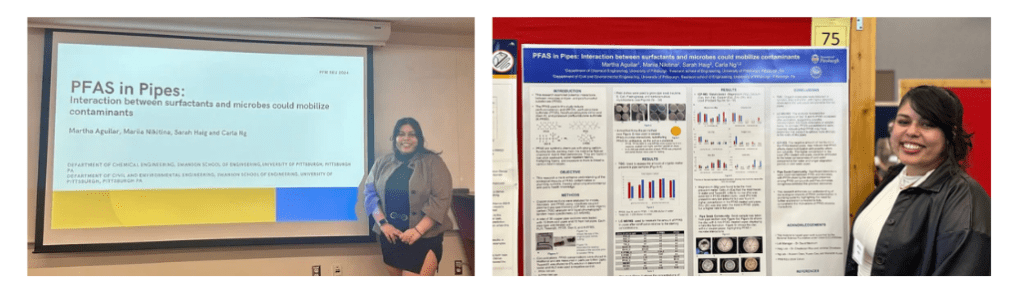
Summer of 2024, I had the amazing opportunity to work in the Haig and Ng Lab at the University of Pittsburgh. My research focused on an important and complex issue, PFAS contamination in drinking water pipes, and specifically, the interactions between surfactants and microbes that could mobilize these contaminants.
What Are PFAS?
Let’s start with the basics. PFAS (Per- and Polyfluoroalkyl Substances) are synthetic chemicals with incredibly strong carbon-fluorine bonds, which makes them nearly impossible to break down. This durability is why they’ve earned the nickname “forever chemicals.” You’ve probably encountered PFAS without realizing it. They are in non-stick cookware, water-repellent fabrics, food packaging, and firefighting foams.
There are nearly 15,000 different PFAS compounds, but my research focused on four:
- Perfluorooctanoic acid (PFOA)
- Perfluorooctane sulfonate (PFOS)
- Hexafluoropropylene dimer acid (GenX)
- Potassium perfluorobutane sulfonate (K-PFBS)
PFOA and PFOS are being phased out, and GenX and K-PFBS are part of a newer generation of fluorinated chemicals, believed to be less persistent in the environment.
Why Do PFAS Matter?
PFAS are commonly found in drinking water, and long-term exposure has been linked to a number of health issues, including thyroid disease, liver damage, kidney cancer, and infertility. My research aimed to investigate how PFAS might help mobilize microbes within drinking water pipes, which could have serious implications for both public health and water treatment processes.
Research Goals
Our research had three primary objectives:
- To better understand how PFAS affects microbial growth in drinking water systems.
- To advance our knowledge of environmental and public health issues linked to PFAS exposure.
- To explore whether microbes might adapt to constant PFAS exposure, and whether they could be involved in breaking down these chemicals.
Research Methods
We used several techniques to gather data:
- Total Organic Carbon (TOC) Analysis: This helped measure the amount of organic matter in the pipe samples.
- LC-MS/MS (Liquid Chromatography-Tandem Mass Spectrometry): Used to measure PFAS concentrations after sonication.
- ICP-MS (Inductively Coupled Plasma Mass Spectrometry): Used to measure metal concentrations (e.g., iron, lead, copper) in the samples.
- Modified Kirby-Bauer Method: Traditionally used to test bacterial resistance to antibiotics, we modified this method to examine how bacteria interact with PFAS.
The Research Process
I began by preparing 30 copper pipe sections (15 for cold water, 15 for hot), each 4 inches long. I filled these pipes with PFAS solutions and subjected them to sonication, a process where sound waves agitate the water and help release particles. After repeating this process, we analyzed the samples using TOC, LC-MS/MS, and ICP-MS.
For the microbial interactions, I swabbed bacteria from the pipes and placed them on agar plates. I prepared stock solutions of PFOS, PFOA, GenX, and K-PFBS, and soaked Whatman paper discs in these solutions to see how different bacteria would respond to each PFAS compound.
Results
- TOC Analysis: We found higher amounts of organic matter in cold water pipes compared to hot, which suggests that lower temperatures slow down decomposition and allow organic matter to accumulate—creating a better environment for microbial growth.
- LC-MS/MS: The concentrations of GenX and K-PFBS increased, likely due to their presence in drinking water sources, while PFOS levels decreased, probably because it adhered to the pipe walls.
- ICP-MS: We saw interesting interactions between PFAS and metals. For instance, PFAS-treated pipes showed negative iron levels, which might indicate that PFAS influences metal mobilization and solubility. Cold pipes had higher lead concentrations, likely due to longer stagnation times.
- Kirby-Bauer Results: PFOA exhibited the strongest effects on bacterial growth, with Pseudomonas aeruginosa showing the greatest resistance. This suggests varied microbial responses to different PFAS compounds.
Conclusion
Our study revealed that PFAS compounds can potentially mobilize both metals and microbes in drinking water systems, raising concerns about public health and water treatment processes. The interactions between PFAS and microbes are complex and require further exploration, but our findings underscore the importance of careful monitoring and management of these chemicals in our water supply.
 Sad Writer Digest